Custom Websites
Lightning-fast, search-ready marketing sites built on Next.js. No page builders, no bloat — just clean engineering that turns visitors into customers.
Next.jsSEO-readyResponsive
WebStar Design crafts lightning-fast websites, powerful web applications and custom AI agents for Jamaican and Caribbean businesses — architected by a veteran software engineer, delivered at AI speed.
The web is shifting from pages people browse to answers machines deliver. Every service we offer is designed for both.
Lightning-fast, search-ready marketing sites built on Next.js. No page builders, no bloat — just clean engineering that turns visitors into customers.
Booking systems, client portals, dashboards and full SaaS products — properly architected from day one, so they scale when you do.
Custom AI agents that answer customer questions, qualify leads and automate repetitive work — trained on your business, on-brand, always on.
Make your business legible to the systems answering your customers' questions: correct structured data, facts in the HTML, AI crawlers verified as unblocked, and one consistent description everywhere it's published.
The same work that makes a site quotable makes it rank: fast server-rendered pages, honest heading structure, clean metadata and sitemaps. Not a separate bet — the fundamentals underneath both.
Hosting, security, updates and continuous optimization. Your site stays fast, safe and ahead of the curve — month after month.
We concentrate on a handful of sectors rather than claiming to serve everyone. It means the questions we ask you are the right ones from the first conversation.
A direct booking channel beside your platform listings, so the bookings you already earn don't all arrive with a commission attached.
The commission problem →Dental, medical, legal, accounting, real estate. Services, practitioner bios, appointment requests — and the structured data that answers "who's the best dentist in Montego Bay?"
Contractors, electricians, cleaning, auto repair. High local-search intent, and customers who decide fast on a phone.
Menu, hours, location and directions as real text a machine can read — not a photographed menu that AI assistants and search engines are blind to.
A handful of items sold with payment links, or a proper small shop on a proven commerce platform. We'll tell you honestly which one you need.
These are the sectors we know deeply, not the only ones we take. If your business runs on being found and being trusted, the same work applies — tell us what you do and we'll say honestly whether we're the right studio for it.
Start a conversation →Anyone can type a prompt. Few can architect a system.
WebStar Design is led by a software engineer with decades of professional experience — system architecture, databases, security and performance. Today's best AI development tools clear the boilerplate; senior engineering judgment handles everything else. The result: enterprise-grade software in a fraction of the traditional time and cost.
AI handles the heavy lifting
Experience makes the difference
Tools change every month. Judgment compounds for decades.
Most small-business sites in this market are assembled from plugins, and that assembly is where the risk actually lives. This is the specific reason we don't build that way.
91%
Not in WordPress core. The platform isn't the weak point — the add-on layer is.
250+
More than most small businesses could track even if tracking it were their job.
~5 hrs
The window to patch is often shorter than the gap between checking your site.
A WebStar site has no plugin layer to leave outdated. Your pages are built and served as static files rather than assembled on every request by a stack of third-party extensions, so the most common way a small-business site gets compromised simply isn't part of how yours works. Security patches to the underlying framework are applied and monitored under your Care Plan, not left for you to notice.
To be fair about it: WordPress is a capable platform in the right hands, and this isn't a refusal to touch it. If you already run a WooCommerce store, we'll give you an honest read on whether keeping it is the right call for your business rather than a reflexive rebuild. We just don't start new sites that way.
Figures reflect published vulnerability research as of mid-2026 and are cited as evidence for how we build, not as a guarantee about any specific site.
Your customers now ask ChatGPT, Gemini, Claude and Perplexity as well as Google. The usual problem isn't that these systems can't find you — it's that the answer comes back vague, outdated or simply wrong, because nothing on your site ever told the machine otherwise.
So we check your site specifically: whether AI crawlers are being blocked, whether your content survives without JavaScript, whether your business is typed correctly in structured data — then fix what's actually broken. And because a consistent description accumulates over years, a competitor starting two years from now can't buy the back catalogue.
No one can guarantee what an AI will say about you — and anyone who does is selling you something they can't deliver. What we can do is make sure the facts it finds are yours, correct, and easy to quote.
A guesthouse is marked up as a lodging business — room rates, check-in times, amenities, coordinates. A practice is marked up as a dental practice — opening hours, procedures. Not one generic “business” label doing duty for both.
Your facts live in the HTML itself. Most AI fetchers don't run JavaScript, so a page that assembles itself in the browser can reach them almost empty.
Site builders and security tools block GPTBot, ClaudeBot and PerplexityBot by default more often than you'd think. We check yours and show you the result.
Name, address, hours and services agreeing across your site, your listings and your Google Business Profile. Contradictions make a source less quotable.
Illustrative example — not a captured result
“I don't have reliable opening hours for dental practices in Montego Bay. I'd suggest calling ahead to check.”
“Yes — Toothsmith Dental Studio on Queens Drive is open Saturdays 9am–2pm, and takes appointment requests online.”
Same business, same question — the difference is what the page gave it to work with
A tight, transparent process refined over decades of shipped software.
A deep dive into your business, your customers and your goals. No jargon, no fluff.
A clear blueprint before any code: stack, structure, timeline and a fixed, honest quote.
AI-accelerated development with senior review at every step. You see progress weekly.
Deployment, analytics, AEO/GEO tuning and ongoing care that keeps you ahead.
One live client site, and four demonstration builds for businesses that don't exist. Every card below says which is which — a portfolio that blurs that line isn't worth showing you.
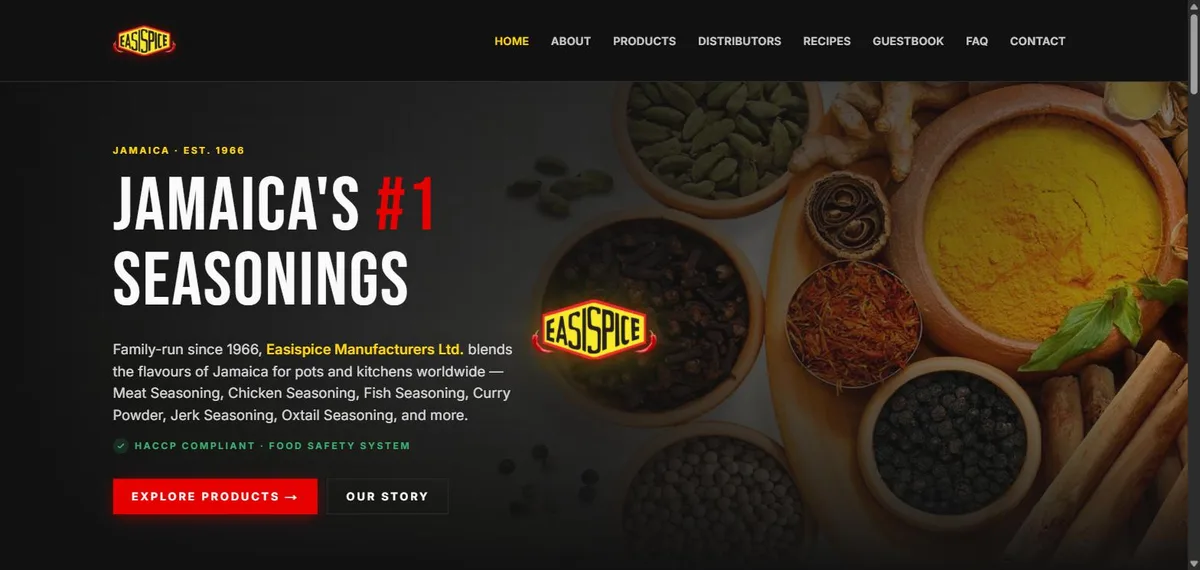
Food manufacturing & distribution · Savanna-la-Mar, Westmoreland
A family-run Jamaican seasoning and spice manufacturer, in business since 1966, selling into retail and distribution at home and abroad.
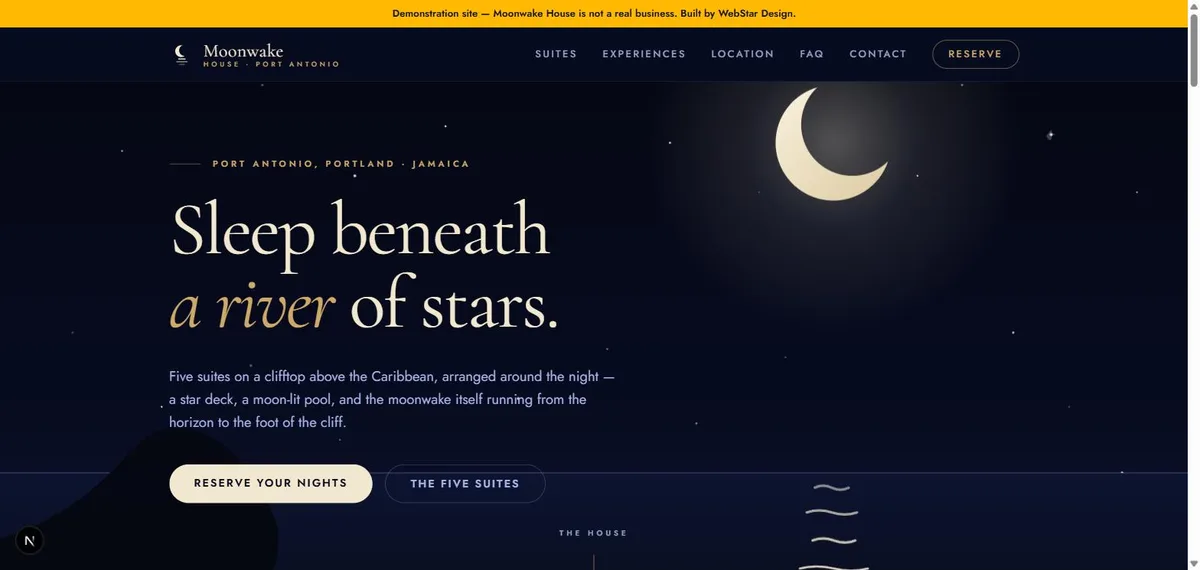
Hospitality — boutique retreat · Port Antonio, Portland
A clifftop, night-themed retreat with five suites, built to show what the Grow tier looks like for a small property that wants direct bookings.
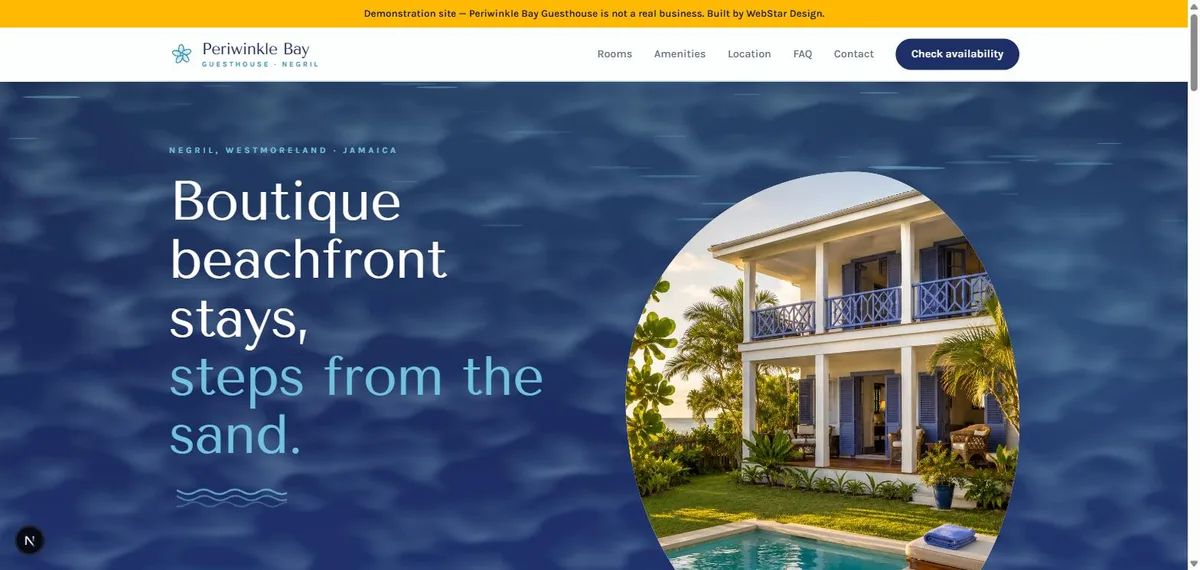
Hospitality — boutique guesthouse · Negril, Westmoreland
A six-room, family-run beachfront guesthouse steps from Seven Mile Beach, built on the Grow tier to show a direct-booking channel a hospitality business can run alongside its OTA listings.
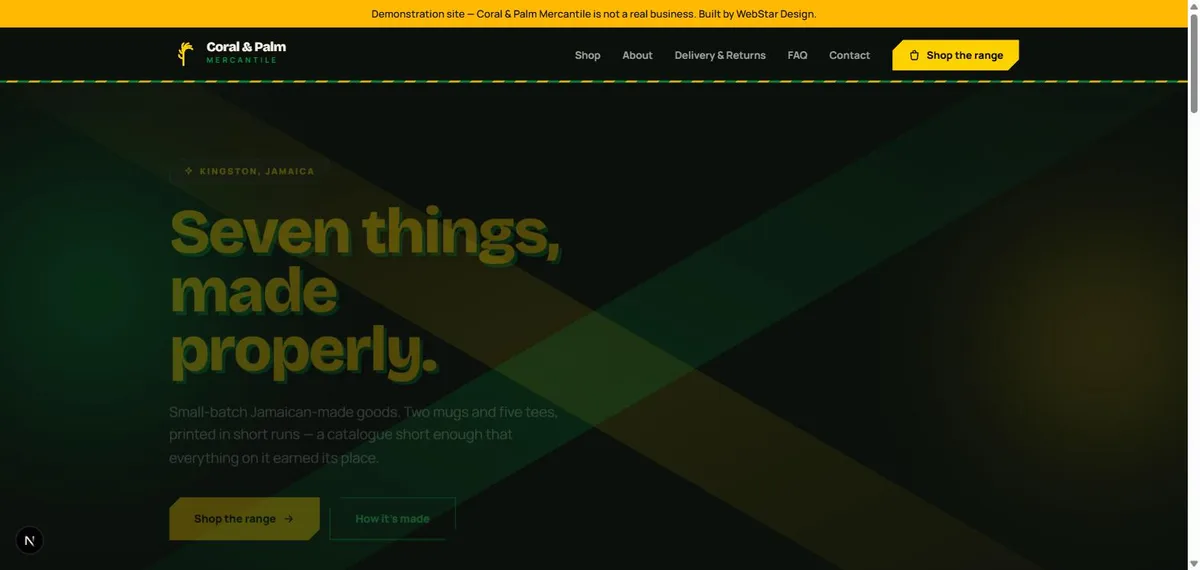
Small-catalogue retail · Kingston
A small-batch goods shop selling Jamaican-made ceramics and printed cotton tees, built on the Launch tier with Quick Buy — a payment link per item, no cart, no Shopify account required.

Clinics & professional services · Ocho Rios, Saint Ann
A family dental practice, built deliberately at the plainer tier to show that the price tracks what a business actually needs rather than an upsell.
WebStar Design is a young studio. Rather than pad a portfolio with work we didn't do, we built four complete sites for invented businesses — spanning hospitality, clinics and retail — and put them here labelled as exactly that. They're not mockups: they run the same structured data, the same AI Concierge and the same build pipeline a paying client gets. Client work joins them as it ships, and only with that client's permission.
Talk about your projectThis isn't a pitch to delete your listing — your listing works, and platform dependency is the normal state for small operators, not a failure. Roughly 63% of independent-property bookings run through the platforms. The question is what happens when a guest who already wants to book with you goes looking for somewhere to do it.
For a lot of small Jamaican properties the honest answer is: nowhere. Search the property name and you find the listing, and nothing else. Every booking that lands on your own site instead keeps the commission you were already earning.
On $100: Airbnb's single fee nets you $84.50. Booking.com at 17% nets you about $83. The same guest direct at $95 via card nets you roughly $92 — the guest saves $5, you keep about $7 more. You don't need to undercut by the full fee to win on both sides. Split it, or add value instead of a discount — late checkout, flexible cancellation — so you don't breach rate parity or train guests to bargain-hunt.
Cleaning fees count too — both platforms take commission on them, not just the nightly rate. And direct isn't free: card processing via your gateway still applies, plus a channel-manager subscription only if you ever add live sync — which this starting point deliberately doesn't include.
Illustrative arithmetic from platform published rates as of mid-2026, not a quote for your listing — your rate, country and programmes set the exact numbers. Check your own dashboard.
Rarely from strangers discovering you cold — almost always from someone already looking for you by name.
Direct rarely finds strangers. It catches people already looking for you — a net, not a magnet. If you have no reviews or repeats yet, expect little direct at first.
Having your own site breaks no rules — millions of hosts have one. What Airbnb penalises is fee circumvention: using their chat or a live reservation to dodge their fee. That escalates from warning to suspension to removal, and their chat filters numbers and links automatically.
Never in Airbnb chat
Safe outside Airbnb
Rule of thumb: on-platform, keep that stay on-platform. Off-platform, after checkout, the relationship is yours — that second part is what we build for.
A guest sends a request through the booking form Grow includes, it reaches you immediately on the channel you already use, and you check your own calendar and confirm. That's the whole mechanism, and it's deliberately simple — it's also why single-property hospitality sites need Grow rather than Launch; Launch doesn't include a dedicated booking form.
It does not sync with your Airbnb or Booking.com calendar on its own, and it won't prevent a double booking for you. Real, two-way calendar sync isn't on the price list yet — it's scoped but unbuilt, and starts as a conversation with the first hospitality client who actually wants it. Running more than one property? That's a separate, not-yet-priced plan. Need it sooner than that? The sister brand, BookingVibe, sells this same two-way sync and online payments as add-ons on a premium direct-booking site (Guesthouse from $3,000 — bookingvibe.com), so the honest referral stays inside the studio.
Underneath the pages, the site describes itself in the structured vocabulary search engines publish for accommodation — schema.org’s LodgingBusiness type, if you want to look it up or hand the term to a developer. Each room type carries its nightly rate; the property carries check-in and check-out times, amenities, map coordinates, and links tying your Airbnb and Booking.com listings to your own site as one business rather than three. It's generated from the same facts the pages show, so the two can't drift apart.
Availability is the one thing it never states. The markup won't claim what your booking form and your Concierge both decline to.
Straight about what this is: it's long-established technical SEO more than anything new, and no on-page markup buys you a starred hotel result in Google — that runs through a separate paid programme. It's included because it's generated rather than hand-written, so it costs nothing extra. And you can check it rather than take our word for it: view the source on either hospitality demo above.
Enough here to know whether we're in your range before we ever talk. Your exact, itemized quote is prepared for you specifically — never a generic rate card.
A complete custom website, live in about 5 business days after sign-off.
≈ J$288,000
+ Care & Growth Plan required after launch, from $75/mo
+ AI Concierge available as an add-on, from $400
Get your exact quoteFor businesses that need their site to capture and qualify new business.
≈ J$480,000
+ Care & Growth Plan required after launch, from $75/mo
Get your exact quoteA headless Shopify store in your own brand — new build, or added to a site we didn't build.
Catalogue size, and whether you already have a site, both change the price.
The same AI Concierge Grow includes standard — appointment requests within your rules, grounded only in your own content. Stacks on Launch.
≈ J$64,000
A handful of fixed items sold with payment-link buttons on your existing pages — no cart, no Shopify subscription. Stacks on Launch or Grow.
Illustrative example — not a live checkout
≈ J$48,000
Bespoke web applications, or a project that doesn't fit one of these tiers. We scope it and send you an exact, itemized quote. No generic rate card, no guessing.
Request a quoteEvery tier ships AI-ready — AEO/GEO structured data is baked into the price, not bolted on as an extra. The AI Concierge is included standard on Grow and above, and a low-cost add-on on Launch.
Priced in USD; JMD figures are indicative at ~J$160/US$ and confirmed in every proposal. No hidden fees — third-party costs (if any) are always itemized separately.
A website isn't a one-time purchase. Software needs patching, content needs refreshing — and AI search engines change how they read the web every few months. The Care & Growth Plan keeps your site fast, safe and positioned for AI-driven discovery, so the asset you paid for keeps appreciating instead of quietly decaying.
From $75/month, tailored to your site's scope. Specialized variants for online shops and hospitality properties are itemized in your private proposal.
Delivered automatically, every month
Every quarter we re-check how AI systems actually describe you, and correct what has drifted — hours, services, listings, anything that now contradicts itself. It's the part that compounds: a business described consistently for years is in a position a newer competitor can't buy their way into.
You'll never wonder what you're paying for — it arrives in your inbox.
The questions we actually get asked, answered plainly — so you can find them, and so can the AI assistants your customers are asking.
A complete custom website from WebStar Design starts at US$1,800 (about J$288,000) for the Launch tier, and from US$3,000 (about J$480,000) for Grow, which adds booking and lead capture. Ongoing care starts at US$75 per month.
Those are honest starting points, not teaser prices. What moves the number is scope — how many pages, whether you need e-commerce, how much of your content needs writing rather than migrating. Your exact, itemised quote is prepared for your project specifically after a short discovery call, never pulled off a generic rate card.
About five business days for a Launch-tier site, measured from sign-off rather than from your first email.
That timeline assumes your content — photos, service details, hours, anything you want said a particular way — is ready when we start; gathering it is usually what actually determines the schedule. Grow builds take longer because booking flows and expanded content need more review, and bespoke web applications are scoped and scheduled individually.
AEO (Answer Engine Optimization) and GEO (Generative Engine Optimization) are two names for the same practice: structuring a business so AI assistants can read it, understand it correctly, and quote it — ChatGPT, Gemini, Claude, Perplexity, Google's AI overviews and voice assistants.
In practice it means schema.org structured data matching your real business type, your facts present as text in the page itself rather than assembled by scripts or trapped in images, a robots.txt and firewall that don't accidentally lock AI crawlers out, and the same name, address, hours and services everywhere your business is listed — not just on your own site.
What it does is improve your eligibility to be found, understood and quoted accurately. Nobody can guarantee a specific ranking, citation or traffic result from an AI engine — and anyone who does is selling you something they can't deliver.
Quite possibly, yes — and that's worth saying plainly rather than pretending otherwise. AI assistants mostly answer from the same web indexes search engines use, so if Google can find you, you're already eligible to be mentioned. Being indexed isn't the thing this work buys.
Two things are worth checking anyway. The first is whether the answer is actually right: wrong hours, an outdated address, services you no longer offer, or a confident guess where your site never stated the fact. The second is whether you're reachable at all — a surprising number of sites sit behind a security setting that returns an error to GPTBot or ClaudeBot while Google walks straight in, and nobody notices because the site looks fine to humans.
Ask an assistant about your own business before you talk to us. If the answer is accurate and complete, you need less from us than you think, and we'll tell you so.
Largely, yes — and Google says so too, which is a point in its favour rather than against it. Most of what makes a site quotable by an AI assistant is the same work that makes it rank: fast server-rendered pages, correct structured data, honest headings, real text instead of pictures of text, and consistent business details across your listings.
The parts that genuinely differ are small but they matter. Whether AI crawlers are allowed through your firewall has no effect on your Google ranking at all, and it's the single most common thing we find broken. ChatGPT doesn't use Google's index, so Google's advice only covers part of the picture. And a page can rank perfectly well while still being hard to quote, if the key fact only makes sense three paragraphs into the section.
The overlap is the reassuring part. You're not buying a speculative bet on where search is heading — you're buying durable fundamentals that serve the new surfaces as well. If AI search stalled tomorrow, you'd still own a fast, well-structured site that ranks.
No — WebStar sites are built on our own Next.js foundation rather than WordPress and a stack of plugins.
The reason is specific rather than snobbery. 91% of disclosed WordPress vulnerabilities are found in plugins rather than in WordPress core, with 250+ new plugin vulnerabilities disclosed each week and exploitation often starting within about five hours of disclosure. A WebStar site has no plugin layer to leave outdated, so your site won't get hacked because of an outdated plugin.
WordPress is a capable platform in the right hands, and this isn't a blanket refusal to touch it — if you already run a WooCommerce store, we'll tell you honestly whether keeping it is the right call for you. We just don't build new sites that way.
Yes, in two forms — and which one is right depends on whether your customers genuinely need a shopping cart.
If you sell a handful of fixed items, where people realistically buy one thing at a time, we wire secure payment-link buttons directly into your normal site pages. No commerce subscription, no separate backend to maintain, and catalogue changes are handled like any other content edit.
If you have a real catalogue and customers buy several things at once, we build on headless Shopify — Shopify runs the catalogue, cart and checkout, but the storefront you and your customers actually see is our own build, in your brand, not a Shopify theme. Local payment gateways such as WiPay or Fygaro handle payment, with both JMD and USD pricing on display. Worth knowing upfront: Shopify Payments isn't available in Jamaica, so a third-party gateway is involved and carries its own fees — those are itemised in your proposal, not left for you to discover on a first invoice. Past roughly 150 products, or with POS and inventory sync, we'd scope it as a bespoke build rather than stretch a standard tier to fit.
Grow and above include an AI Concierge as standard; on Launch, it's a low-cost add-on rather than bundled in. Either way it's the same chat assistant — one that answers your visitors using your actual business information, not generic internet knowledge, and includes appointment-request handling.
It's grounded in what you tell us during onboarding — services, hours, location, policies, and anything else you want it to know. Just as importantly, it's built to hand off rather than improvise: it won't confirm a booking, promise availability or quote a price it hasn't been given.
No. WebStar Design is based in Kingston and works across the wider Caribbean — Jamaica, Barbados, Trinidad and Tobago, The Bahamas, the Cayman Islands and neighbouring markets — in your time zone rather than several hours ahead of it.
Enquiries from the diaspora are welcome too. Jamaicans and Caribbean families abroad often fund or commission a website for a family business back home; billing is USD-primary, so paying from overseas is straightforward.
Prices are quoted in US dollars, with the Jamaican dollar equivalent shown alongside. The JMD figures on this site are indicative at roughly J$160 to US$1 and are confirmed at the current rate in every proposal.
USD is the primary currency because the costs underneath — hosting, infrastructure, AI usage — are USD-denominated, so quoting that way keeps your price stable instead of drifting with the exchange rate. Payment arrangements are confirmed in your proposal.
Yes. The site, its content and its design are yours.
One thing worth being upfront about: hosting and DNS are managed under WebStar's own infrastructure account on your behalf, rather than an account you administer day to day. That's what makes the Care Plan's monitoring, patching and fast recovery possible. Your services agreement sets out the offboarding terms in plain language — what you receive and how hosting and DNS transfer to you if we ever part ways. Nothing is held hostage.
Yes — every site WebStar launches runs on a Care & Growth Plan, from US$75 per month (about J$12,000).
It isn't an optional extra bolted on after launch; it's the hosting your site actually runs on, plus security patching, uptime monitoring, minor content edits, a monthly report, and a quarterly check of how AI systems are describing you so drifting details get corrected rather than quietly compounding. A site left unmaintained gets slower, less secure and less accurate every month, and we'd rather not put our name on that outcome.
Something we haven't covered? Ask us directly
Nobody else in this market is writing about how AI assistants decide which businesses to name. So we do — in plain language, with the honest limits stated.
We understand the Caribbean market because we live in it — customers who browse on mobile over hotel Wi-Fi, businesses that run on WhatsApp, tourism that moves with the seasons. We build for that reality, then optimize for the world.
We know how Caribbean customers search, shop and book.
Fast on real Caribbean networks and real devices.
Booking-ready sites for the region's biggest industry.
Same hours, same wavelength — no offshore lag.
Plenty of Jamaican and Caribbean families overseas fund or arrange a website for a business back home — a parent's guesthouse, a sibling's practice, the family shop. We work that way happily. Pricing is quoted in USD, updates come to you as well as to them, and the time difference has never been the hard part.

Founder & Lead Engineer
Patrick has over 30 years of experience in software development, including delivering high-level technology solutions for the Government of Jamaica and the health insurance sector — bringing enterprise-grade engineering practices, reliability, and disciplined project execution to organizations of every size.
He specializes in designing and building high-performance websites and custom web applications using Next.js, creating fast, secure, scalable, and search-engine-friendly digital experiences tailored to each client's business requirements. Patrick also develops and integrates AI agent workflows that automate repetitive tasks, streamline operations, connect disparate systems, and deliver intelligent customer experiences.
Rather than relying on WordPress, Patrick builds custom solutions from the ground up. WordPress remains suitable for many use cases, but its heavy dependence on third-party themes and plugins can increase maintenance overhead, security risk, and development constraints — a custom Next.js architecture offers greater flexibility, stronger performance, enhanced security, and virtually unlimited room to grow.
Let's build somethingWhether it's a new website, a web app, an AI agent or making sure AI search engines can find you — the first conversation is free and genuinely useful. The more you share below, the more specific that first reply can be.
Serving Jamaica & the wider Caribbean
Typical response time